Centro de la Memoria Monseñor Juan Gerardi Guatemala
Honoring Victims of the Internal Armed Conflict in Guatemala
Following the recommendations made by the Comisión para el Esclarecimiento Histórico (CEH) and the Proyecto Interdiocesano de Recuperación de la Memoria Histórica (REMHI) Informe Guatemala: Nunca Más, the Oficina de Derechos Humanos del Arzobispado de Guatemala has produced various publications to honor all the victims of repression, violence, and terror experienced during the internal armed conflict.
Seeking to restore dignity to all affected sectors, ODHAG launched this series of publications in 2002, driven by its primary mission to ensure that Guatemalan society does not suffer the terrible consequences that can arise from an official policy of forgetting. The CEH and the REMHI Project established in their reports that the Guatemalan State has an obligation to promote the recovery of memory, to honor the victims, and to support all efforts aimed at achieving these goals.
This collection comprises 11 publications that seek to keep alive the memory of the martyrs, the disappeared, the victims, and the survivors of the internal armed conflict that lasted 36 years.
Full scans of the titles listed below can be found at http://www.odhag.org.gt/publicaciones/publicaciones-area-de-cultura-de-paz/.
17. "Memorias vivas de una luz". Reconstruyendo una verdad histórica. Publicación de homenaje a Mujeres de Esperanza.
["Living Memories of a Light." Reconstructing a historical truth. Publication of tribute to Women of Hope]
This publication is a heartfelt tribute and recognition offered by the Oficina de Derechos Humanos del Arzobispado de Guatemala (ODHAG) to the women survivors of the armed conflict who are examples of struggle, life and hope.
Twenty years ago, Guatemala endured a holocaust of death, pain, indiscriminate violence, and destruction -- events that have left deep marks and scars, and have even shaped the paths of life of all who experienced them.
18. "Testigos de la fe por la paz". Vidas ejemplares de la Iglesia Católica de Guatemala.
["Witnesses of faith for peace." Exemplary lives from the Catholic Church in Guatemala.]
This second edition includes an account of the life and work of Monsignor Juan José Gerardi Conedera, Martyr for Truth and Peace, and is enriched with the life stories of the 14 Blessed Martyrs of Guatemala. It also includes the life stories of 29 martyrs who have not yet been declared as such by the Vatican; while the beatification process has begun for some, all of them are regarded as martyrs by the Guatemalan people due to their exemplary lives and commitment to the gospel.
19. "Era tras la vida por lo que íbamos". Reconocimiento a jóvenes del Movimiento Estudiantil Guatemalteco.
["It was life that we were striving for." A tribute to the youth of the Guatemalan Student Movement]
On the sixth anniversary of the martyrdom of Monsignor Gerardi, ODHAG has compiled and researched the names, faces, lives, and struggles of young students who lost their lives -- whether murdered or disappeared -- within the framework of the struggles of the Student Movement. This publication is presented to Guatemalan society as a tribute, 20 years later, to the youth committed to the reality of the country.
20. "Y la verdad nos hará libres". Reconocimiento a la labor periodística en Guatemala.
["And the truth will set us free." Recognition of journalistic work in Guatemala]
"And the truth will set us free" recovers the memories, lives, work, desires, victories and struggles of the journalistic community.
The first part of the document aims to capture the context in which these acts of violence and terror occurred. It includes contributions from indivduals across various sectors -- such as Joaquín Medina Bermejo, who offers the perspective of a journalist active within professional associations and media outlets. It also addresses the men and women involved, as well as the social, economic, and political conditions that have affected and continue to affect the work of communicators striving to bring the truth to light.
21. "Demos a la Niñez un futuro de paz". Por la dignificación de la niñez víctima del conflicto armado interno.
["Let us give children a future of peace." Honoring children who were victims of the internal armed conflict.]
Following the recommendations made at the time by both the Comisión para el Esclarecimiento Histórico and the Proyecto Interdiocesano de Recuperación de la Memoria Histórica, the Oficina de Derechos Humanos del Arzobispado de Guatemala offers this tribute to all the victims of repression and intolerance who, like Monsignor Gerardi, poured their suffering for the construction of a different Guatemala.
The fundamental purpose of this publication is to honor the memory of Guatemalan children, who, without explanation, found themselves caught up in a war that only brought pain, destruction, mistrust, and fear to society; a war that was not theirs, but one in which they were doubly victimized due to their vulnerability.
22. "Lucha, dolor y esperanza para el campesinado guatemalteco". Reconocimiento al pueblo campesino guatemalteco víctima del conflicto armado interno.
["Struggle, pain and hope for Guatemalan farmers". Recognition of Guatemalan farmers as victims of the internal armed conflict]
For the sixth consecutive year, the Oficina de Derechos Humanos del Arzobispado de Guatemala presents to the general public a work that seeks to restore dignity to the victims of the internal armed conflict. This work focuses specifically on Guatemalan farmers, the largest and most diverse social group whose struggles, lives, and historical suffering are being honored in this way.
23. ¿Por qué ellos y ellas? En memoria de los mártires desaparecidos y sobrevivientes del movimiento sindical de Guatemala.
[Why them? In memory of the disappeared martyrs and survivors of the Guatemalan trade union movement]
Marking the eleventh anniversary of the martyrdom of Monsignor Juan José Gerardi Conedera, this publication reclaims the memory, lives and struggles of Guatemala's trade union movement. This effort aims to serve as a necessary tool for society in general, and especially for new generations, to learn about the country's recent history.
It presents the life stories of 16 trade unionists, men and women, seeking to honor their struggles and efforts to build a different Guatemala, one where the right to organize is respected.
24. "La solidaridad era la base de sus vidas" En memoria de los mártires, desaparecidos y sobrevivientes del magisterio de Guatemala.
["Solidarity was the foundation of their lives" In memory of the martyrs, the disappeared and the survivors among Guatemala's teachers]
To mark the twelfth anniversary of the martyrdom of Monsignor Juan José Gerardi Conedera, the Oficina de Derechos Humanos del Arzobispado de Guatemala (ODHAG) and the Facultad Latinoamericana de Ciencias Sociales, Sede Académica Guatemala (FLACSO) present the research study "Solidarity was the fundation of their lives” to Guatemalan society. This publication honors the memory of the martyrs, the disappeared, and the survivors among Guatemala's teachers.
The publication presents the life stories of 14 teachers who were committed to children, education, and a different kind Guatemala, as Monsignor Gerardi would say.
25. "Testigos del Morral Sagrado". En homenaje a los Catequistas sobrevivientes que han trabajado con dedicación, aun arriesgando la propia vida, por la construcción del Reino de Dios.
["Witnesses of the Sacred Satchel". In homage to the surviving Catechists who have worked with dedication, even risking their own lives, to build the Kingdom of God]
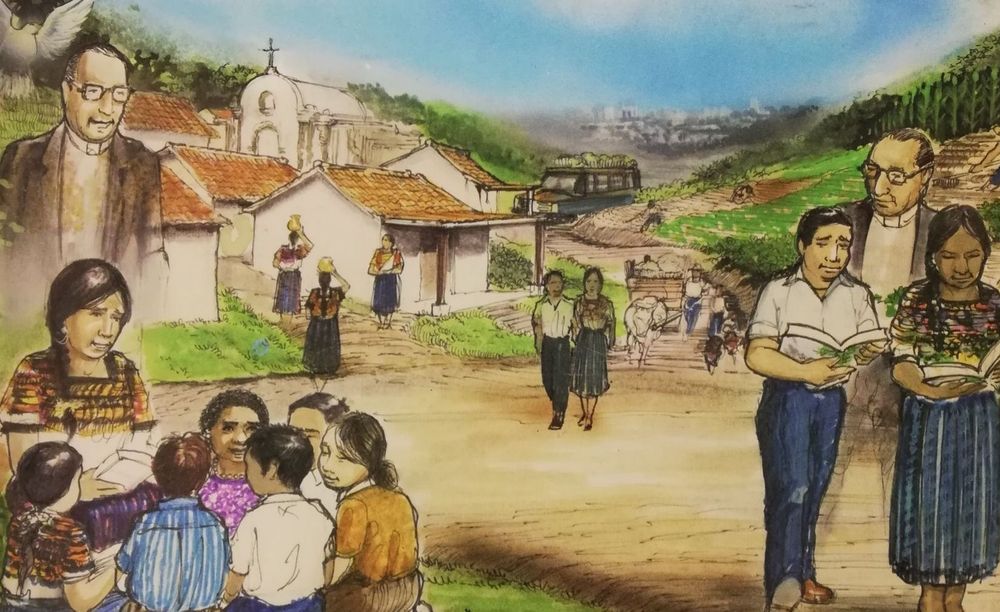
A story narrated in the first person by four real men who experienced firsthand the profound horrors of the war, which divided Guatemalans during 36 long years of internal armed conflict.
These catechists are leaders of Christian communities that grew in the momentum of Acción Católica in the Guatemalan highlands and the Delegados de la Palabra movement in Izabal. All of them belong to "martyr churches", communities ravaged by persecution, particularly during the 1980s in Guatemala.
26. "Por reflejar el alma de un pueblo". El arte guatemalteco en la historia reciente del país.
["Reflecting the soul of a people." Guatemalan art in the recent history of the country]
This investigation comprises three parts. The first outlines the historical context, locating us in the Guatemala of that era -- its social, political and cultural landscape -- and provides an overview to better understand the situation of the country from 1944 onwards.
The second part presents the life stories of eight artists committed to the creation of a different Guatemala; through their various forms of expression they sought to reflect the soul of the people, and as a result, fell victim to repression and persecution.
Finally, the third part is an attempt to recover the names and details of the human rights violations committed against this sector of society during the period of the armed conflict in Guatemala.
27. "Silenciaron nuestra historia... ahora queremos justicia". Las violaciones a los derechos humanos cometidas contra las mujeres durante el Conflicto Armado Interno en la región Q´eqchí´.
["Our story was silenced... now we want justice." Human rights violations committed against women during the internal armed conflict in the Q'eqchí' region.]
In order to understand and raise awareness of the specific women's rights violated during the internal armed conflict, it is necessary to identify exactly which rights were infringed upon and the various ways these violations occurred within that context. Although human rights are presumed to be universally applicable, certain factors—such as gender-based violence, the feminization of poverty, feminicide, and discrimination against women—reveal inequalities in how these rights are applied to women.
In this vein, the primary objective of this investigation is to help identify these violations against women during the internal armed conflict, focusing on Q'eqchi' women in general, and of six communities in particular: Cambayal and Sesajal, in the municipality of San Pedro Carchá, and Sesuchaj, Semox Setinta, Carolina, and Santa Lucía Cajcán, in the municipality of Chisec, all in the department of Alta Verapaz.