Social Movements in Cold War Latin America
Home
Latin America found itself at the crossroads of two global developments after the Second World War: The first was a reduced demand for Latin American commodities. The second was Latin American governments’ shift away from supporting left-leaning social movements, as to not antagonize their relationship with the United States. Each of these developments coincided with the emergence of the Cold War during the mid-to-late 1940s between the United States and the Soviet Union.[1]
The economic depression and political shift led to the emergence of various social movements in opposition to or in favor of the United States' political and economic role in the region. Since the independence of Spanish America during the early nineteenth century, the United States has positioned itself to be the sole sphere of influence in the region through the framework of the Monroe Doctrine.[2] With the advent of the Great Depression and the Second World War, Latin American political actors and nations would vacillate between opposing and cooperating with the United States’ self-proclaimed jurisdiction.
The United States’ renewed intervention in Latin America marked the start of the Cold War in Latin America for the remaining fifty years of the twentieth century. Beginning with the 1954 coup in Guatemala, the U.S. supported coups, military dictatorships, and proxy wars in Central America and the Southern Cone to protect its interests.[3] Fidel Castro’s Cuban Revolution in 1959 and its subsequent Soviet Union-backed communist movement reaffirmed the United States’ perceived need to intervene in the region. The resulting dispossession of land in favor of U.S. economic interests prompted many Latin American activists to develop social and political movements, which led to state-sponsored repression and escalating cycles of violence through the end of the century.
While the Cold War appeared to end with the dissolution of the Soviet Union in 1991, the previous half-century’s ideological tensions persisted. Communist Cuba was no longer supported by the Soviet Union, and now had to face a U.S.-imposed embargo. Civil wars in Central America, such as those in El Salvador, Nicaragua and Guatemala, continued into the 1990s.[4] Argentina, Brazil, Chile, and Uruguay were recovering from decades of military dictatorships. The most significant and longest lasting effect on Latin America was the emergence of neoliberalism during the mid-1980s through the early 1990s.[5] In the absence of the Soviet Union to counter its authority, the U.S. increased its involvement in global geopolitics and spread neoliberalism, establishing a new global economic order.
Neoliberalism changed the daily lives of Latin Americans. It widened the income equality gap across the region through the cutting of social services and the privatization of public infrastructure. Attempting to meet the new economic demands of neoliberalism, many Latin American governments promoted neoliberal democratic and economic reforms.[6] To this day, the repercussions of the Cold War in Latin America continue to be felt.
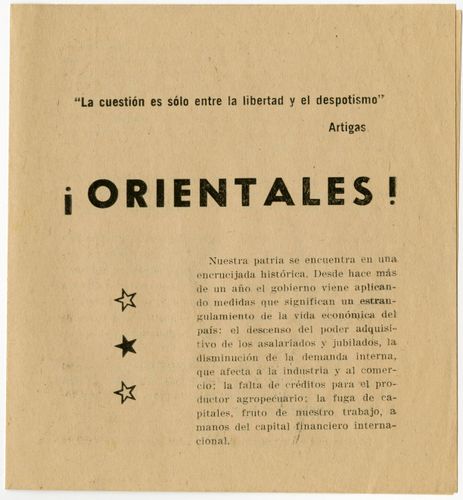
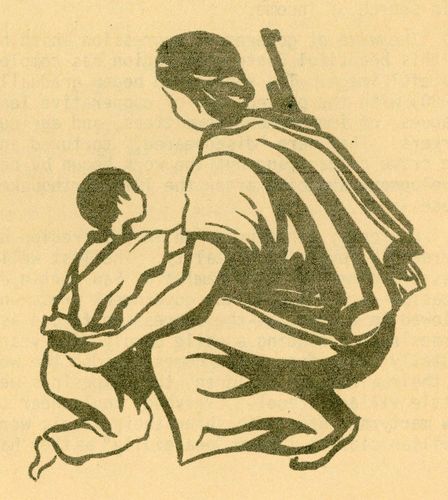
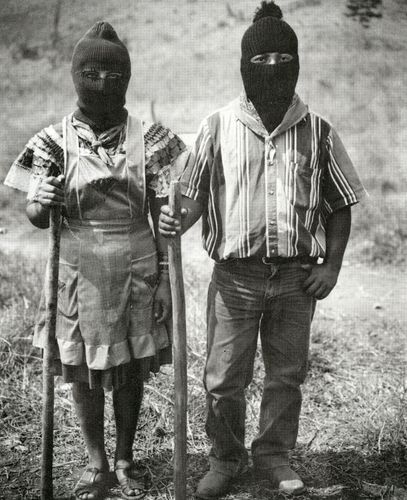
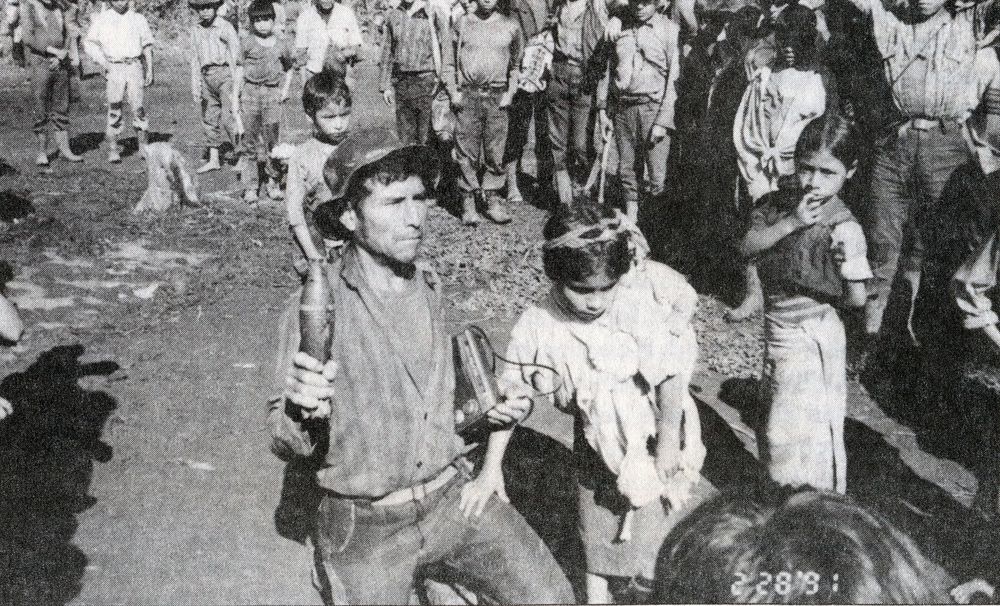
This exhibition explores the various Latin American movements that emerged before, during, and after the Cold War. The first section explores how student activism and their ideas came to be at the forefront of protesting against Uruguay’s crisis of the 1960s before the rise of the civic-military dictatorship in 1973. The second section focuses on Guatemala‘s counterinsurgent movement and civil war that lasted over thirty years after the U.S.-sponsored coup d'état in 1954. To understand the lasting effects of the Cold War, the final section explores the first years of Indigenous activism in Mexico through the Zapatista Movement, tracing its transition from guerilla warfare to mass protests.
-- introduction by Adrián Fernández (B.A. in History and Latin American Studies)
[1] Leslie Bethel and Ian Roxborough, “Introduction: The postwar conjuncture in Latin America: democracy, labor, and the Left,” in Latin America between the Second World War and the Cold War, 1944–1948, ed. Leslie Bethel and Ian Roxborough (Cambridge University Press, 1993), 1–32.
[2] David Bushnell and Neill Macauly, “The Founding of a New Political System” in The Emergence of Latin America in the Nineteenth Century (Oxford University Press, 1994), 13–38.
[3] For a short summary of the Guatemala’s coup d'état in 1954, see Odd Arne Westad, “The Cold War in Latin America” in The Cold War: A World History (Basic Books, 2017), 345–347. For a discussion on the coups d'état in the Southern Cone, see Sebastián Carassai and Kevin Colmeman, “Introduction: The Coup d'état in Latin America, 1964–1982” in Coups d'état in Cold War Latin America, 1964–1982 (Cambridge University Press, 2025), 1–25. For more of a historiographical discussion on Latin America in Cold War, see Gilbert M. Joseph “What We Now Know and Should Know: Bringing Ltin America More Meaningfully into Cold War Studies” in In From the Cold: Latin America’s New Encounter with the Cold War, ed. Gilbert M. Joseph and Daniela Spenser (Duke University Press, 2008), 3–46 and Virginia Garrard-Burnett, Mark Atwood Lawrence, and Julio E. Moreno, “Introduction” in Beyond the Eagle’s Shadow: New Histories of Latin America’s Cold War, ed. Virginia Garrard-Burnett, Mark Atwood Lawrence, and Julio E. Moreno (New Mexico University Press, 2013), 1–20.
[4] Greg Grandin, The Last Colonial Massacre: Latin America in the Cold War (University of Chicago Press, 2011).
[5] Jorge G. Castañeda, “A Latin America Dilemma” in Utopia Unarmed: The Latin American Left After the Cold War (Alfred A. Knopf, 1993), 427–476.
[6] Jorge G. Castañeda, “Democraticizing Democracy” in Utopia Unarmed: The Latin American Left After the Cold War (Alfred A. Knopf, 1993), 358–390.